
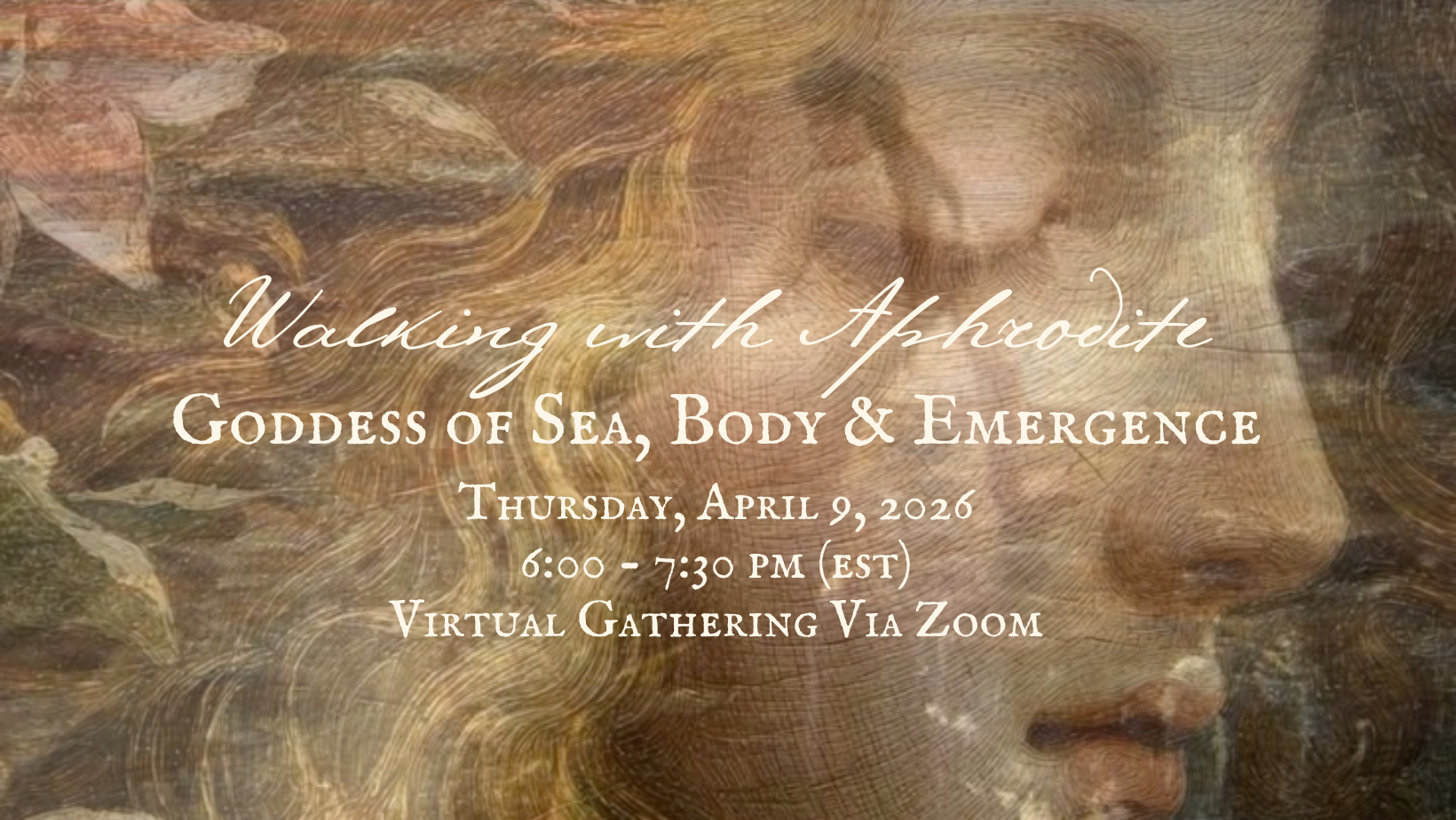
April brings us into the presence of Aphrodite—not as an ideal of beauty, but as a goddess of the body, the senses, and the living world.
Among the ancient Greeks, she was not distant. She was honored at the edges of the sea, in harbors and coastal sanctuaries, carried onto ships and called upon for safe passage, favorable winds, and the fulfillment of what was most deeply desired. She was known not only through story, but through contact—through oil, scent, water, and the daily acts of tending that brought her close.
Long before she was shaped into Greek myth, her presence moved across the Mediterranean, with roots reaching back through older traditions connected to Inanna, Ishtar, and Astarte. In places like Cyprus, she was worshipped through oil, incense, flowers, and acts of care woven into ordinary life rather than set apart from it.
She is a goddess of emergence.
Of the sea, of the body, of what rises into form and asks to be felt.
In April, as the land begins to quicken, we meet her in that same movement—the return of warmth, sensation, beauty, and responsiveness. Not the first thaw, but what follows: when the body begins to answer the world again.
What We’ll Explore Together
Aphrodite in the Greek World
How she was known and honored in Greece—her temples, her epithets, and the ways she was woven into daily and civic life. From coastal sanctuaries to household devotion, she was approached through offering, adornment, and acts of care.
Before Greece — Her Older Lineage
The deeper current she emerges from, connected to earlier goddesses of the Eastern Mediterranean such as Inanna, Ishtar, and Astarte—carrying forward themes of fertility, sexuality, and embodied power.
Sacred Devotion
The role of altars, oil, incense, flowers, and perfume in her rites. The tending of her spaces not as occasional ritual, but as an ongoing relationship.
The Body as Sacred Ground
How the body was engaged directly in her worship—washed, anointed, perfumed, and adorned as part of devotional life.
Aphrodite’s Living World
Her connection to the sea, to coastal sanctuaries, to gardens and flowering plants—the places where life rises into form. In the Greek world, she was honored where land meets water, where movement, desire, and change were most strongly felt.
Working With Aphrodite
In this gathering, we’ll explore how Aphrodite was engaged through ancient ritual—and how we can continue to engage with her through altars, offerings, scent, and the tending of the body and the spaces around it.
We’ll look closely at the plants and materials associated with her—rose, myrtle, apple, pomegranate, and honey—and how these were used in devotion, alongside oil, perfume, and water in her rites. We’ll also explore how to work with these elements directly: creating space, noticing what is coming into bloom, and bringing attention to the sensory world as a way of entering into relationship.
This is not symbolic work.
It is a return to what the Greeks understood well— that the sacred was encountered through the body, through the natural world, and through acts of attention that made the unseen tangible.
These are not casual gestures, but acts of devotion: tending, anointing, adorning, attending—ways of entering into relationship with her through the body and the living world.
You Will Receive
A carefully developed guide for this gathering, including historical context, reflections, and practices
Access to the recorded gathering (available for a limited time) and presentation
A living resource list of readings and materials for those who wish to continue exploring
A small, intimate circle of women
Investment: $45